
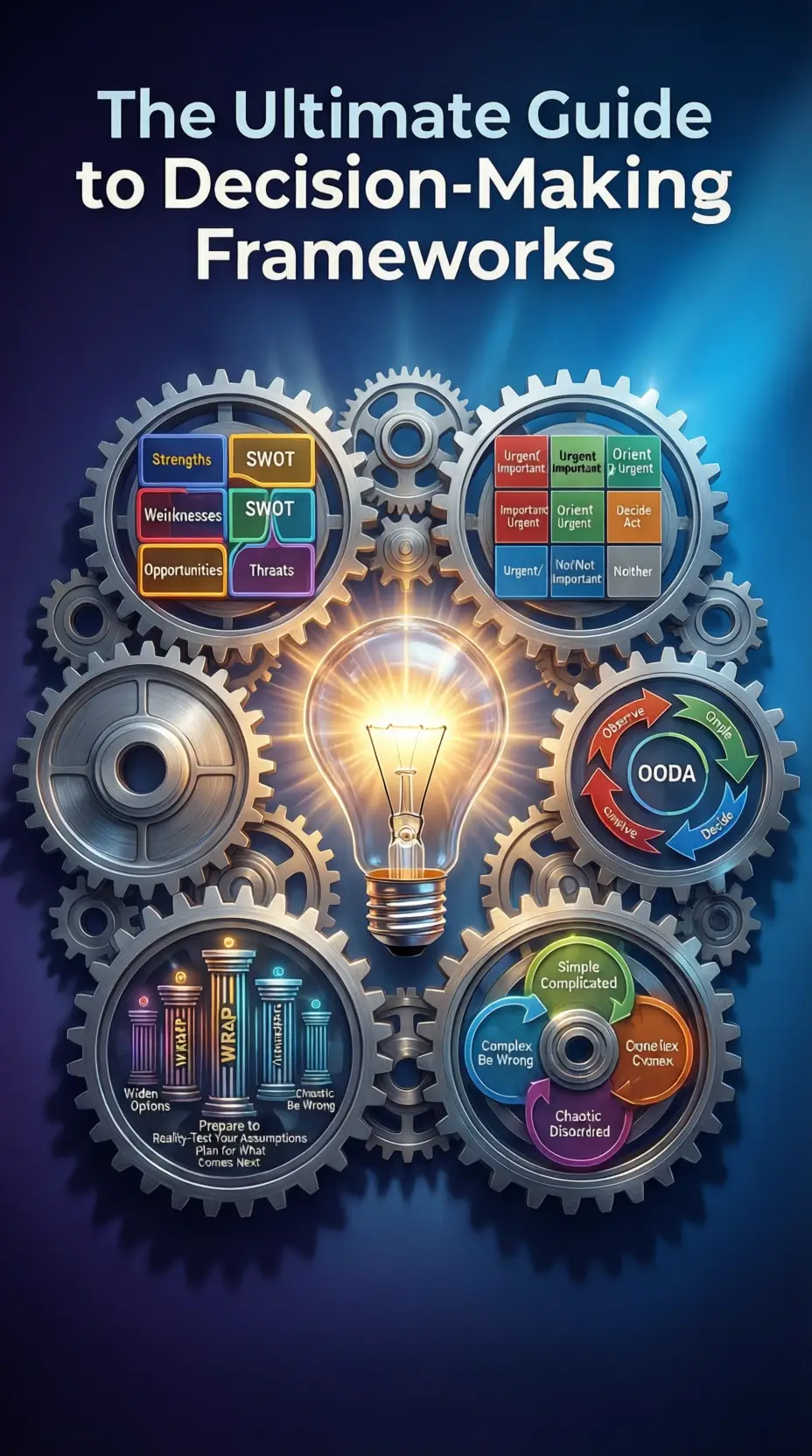
Compare and contrast popular frameworks (e.g., SWOT, Eisenhower Matrix, OODA Loop, WRAP from Decisive, Cynefin) with real-world examples. Include downloadable comparison chart.
The Ultimate Guide to Decision-Making Frameworks: Tools Every Strategic Thinker Should Know
Every day, we make thousands of decisions—most small, some life-changing. But when the stakes are high, intuition alone isn’t enough. That’s where decision making frameworks come in.
Strategic thinkers don’t rely on gut feelings; they rely on structured thinking. The right framework helps you clarify options, reduce bias, and act with confidence—whether you’re choosing a career path, launching a product, or responding to uncertainty.
In this ultimate guide, we’ll explore the most powerful strategic decision making frameworks, compare when to use each, and show real-world examples so you can apply them immediately.
1. SWOT Analysis
Best for: Strategic planning and big-picture decisions
What it is
SWOT stands for Strengths, Weaknesses, Opportunities, and Threats. It’s one of the most widely used decision making frameworks in business and strategy.
How it works
You map internal factors (strengths and weaknesses) against external factors (opportunities and threats).
Example
A startup deciding whether to enter a new market:
-
Strengths: Strong engineering team
-
Weaknesses: Limited marketing budget
-
Opportunities: Growing demand in niche market
-
Threats: Well-funded competitors
Pros
✔ Simple and intuitive
✔ Great for alignment and brainstorming
Cons
✘ Static snapshot (not time-sensitive)
✘ Can oversimplify complex dynamics
2. Eisenhower Matrix
Best for: Prioritization and productivity decisions
What it is
Popularized by President Dwight D. Eisenhower, this framework sorts tasks into four quadrants:
-
Urgent & Important
-
Important but Not Urgent
-
Urgent but Not Important
-
Neither Urgent nor Important
Example
A manager overwhelmed with tasks uses the matrix to identify what to delegate, schedule, or eliminate.
Pros
✔ Excellent for day-to-day decision clarity
✔ Prevents burnout and false urgency
Cons
✘ Not suitable for long-term strategic decisions
3. OODA Loop
Best for: Fast-moving, competitive environments
What it is
Developed by military strategist John Boyd, OODA stands for:
Observe → Orient → Decide → Act
It’s a continuous feedback loop designed for rapid decision-making.
Example
A startup reacting to a competitor’s sudden pricing change:
-
Observe: Market reaction
-
Orient: Analyze customer behavior
-
Decide: Adjust pricing strategy
-
Act: Roll out changes quickly
Pros
✔ Ideal for uncertainty and speed
✔ Encourages learning and adaptation
Cons
✘ Less structured for slow, analytical decisions
4. WRAP Framework (from Decisive by Chip & Dan Heath)
Best for: Avoiding cognitive bias
What it is
WRAP is designed to counter common decision traps:
-
Widen your options
-
Reality-test your assumptions
-
Attain distance before deciding
-
Prepare to be wrong
Example
Someone choosing between two job offers widens options by negotiating role scope instead of just salary.
Pros
✔ Excellent for personal and leadership decisions
✔ Explicitly addresses bias
Cons
✘ Requires time and deliberate effort
5. Cynefin Framework
Best for: Complex and uncertain systems
What it is
Cynefin categorizes problems into five domains:
-
Clear (best practices)
-
Complicated (expert analysis)
-
Complex (experimentation)
-
Chaotic (act immediately)
-
Disorder (unknown)
Example
During a crisis (e.g., system outage), leaders act first (chaotic), then stabilize before analyzing.
Pros
✔ Powerful for leadership and organizational strategy
✔ Helps avoid applying the wrong solution
Cons
✘ Steeper learning curve
✘ Less intuitive for beginners
Comparison Chart: Decision-Making Frameworks
| Framework | Best For | Speed | Complexity | Ideal Use Case |
|---|---|---|---|---|
| SWOT | Strategy | Medium | Low | Market & business planning |
| Eisenhower Matrix | Prioritization | Fast | Low | Task & time management |
| OODA Loop | Rapid response | Very Fast | Medium | Competitive environments |
| WRAP | Bias reduction | Medium | Medium | High-stakes decisions |
| Cynefin | Uncertainty | Variable | High | Complex systems & crises |
How to Choose the Right Framework
Ask yourself:
-
Is this decision urgent or strategic?
-
How much uncertainty is involved?
-
Do I need speed or depth?
-
Am I at risk of bias or overconfidence?
Strategic decision making isn’t about finding one perfect framework—it’s about knowing which tool to use and when.
Final Thoughts: Think in Systems, Decide with Confidence
Great decisions are rarely accidental. The best leaders, founders, and thinkers build a decision toolkit—a set of frameworks they can apply across situations.
Mastering decision making frameworks won’t eliminate uncertainty, but it will give you clarity, consistency, and confidence when it matters most.