
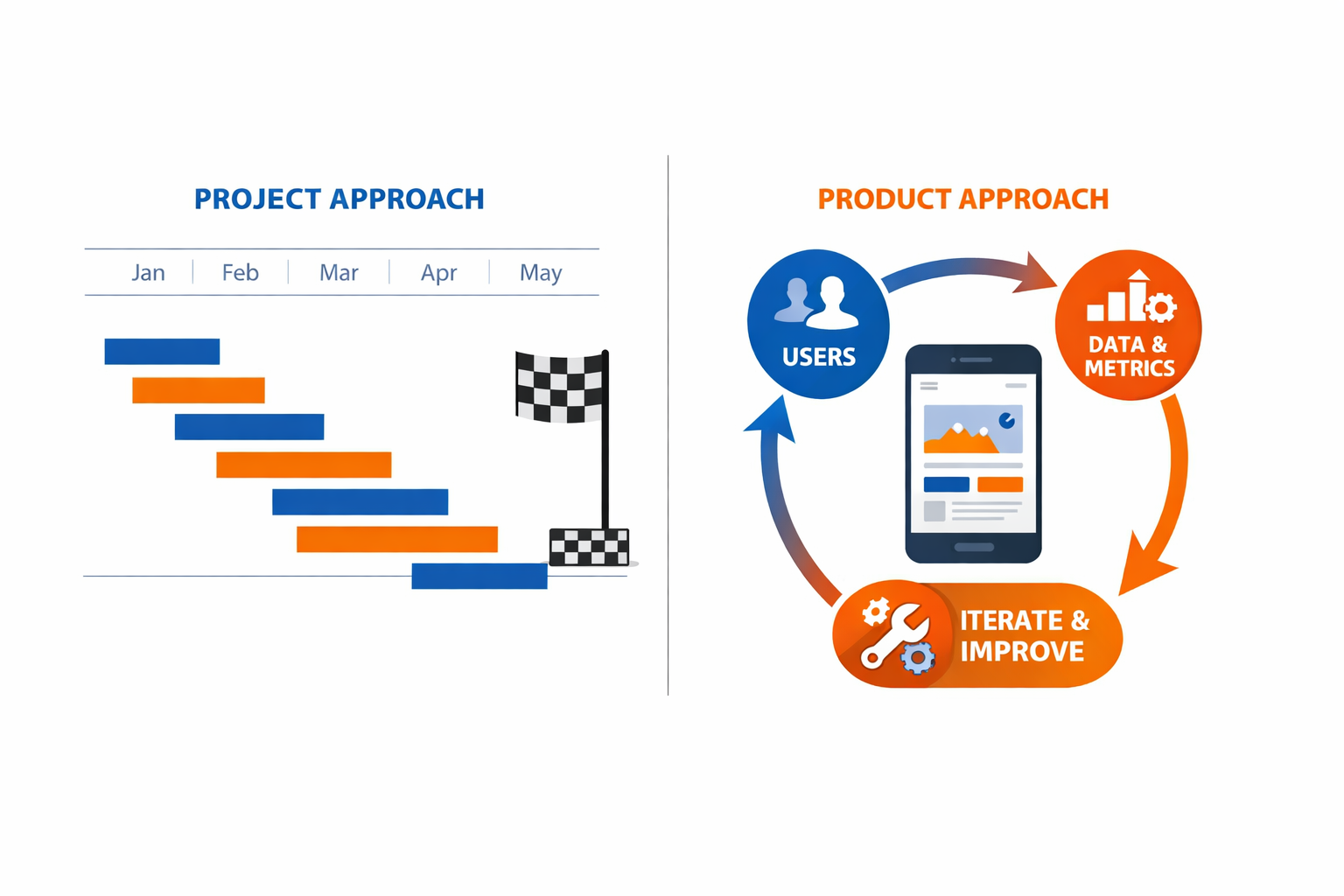
In today’s fast-moving digital landscape, the way organizations make decisions determines whether they merely deliver features or actually solve customer problems. The fundamental choice isn’t about methodology—it’s about mindset: product-based versus project-based decision making.
While project-based thinking dominated the 20th century, forward-thinking companies are shifting toward product-based approaches that prioritize continuous value creation over one-time deliverables. Understanding this distinction isn’t just academic—it’s strategic.
What Is Project-Based Decision Making?
Project-based decision making centers on outputs: completing predefined scope within fixed constraints of time, budget, and resources.
Core characteristics:
- Fixed start and end dates with a defined “done” state
- Success measured by on-time, on-budget delivery
- Requirements locked early in the process
- Focus on task completion and milestone achievement
- Temporary teams assembled for duration of project
Example: “We need to launch the mobile app redesign by Q3 with these 15 features for $250K.”
Project thinking asks: “Can we deliver what we promised on schedule?”
What Is Product-Based Decision Making?
Product-based decision making centers on outcomes: creating sustained value for users and the business through continuous learning and adaptation.
adaptmethodology.com
Core characteristics:
- Ongoing investment without predetermined end date
- Success measured by business impact and user behavior change
- Requirements evolve based on data and feedback
- Focus on solving real problems, not checking feature boxes
- Dedicated, cross-functional teams with long-term ownership
Example: “We need to increase user retention by 20% through continuous improvements to our onboarding experience, validated by weekly user testing.”
Product thinking asks: “Are we solving the right problem in the right way for our users?”
Key Differences at a Glance
Dimension | Project-Based Approach | Product-Based Approach |
|---|---|---|
Time Horizon | Temporary (fixed duration) | Continuous (ongoing investment) |
Success Metric | On-time, on-budget delivery | Customer outcomes & business impact |
Planning Style | Upfront detailed planning | Adaptive roadmap with frequent pivots |
Team Structure | Temporary, siloed resources | Dedicated, cross-functional squads |
Risk Management | Risk mitigation through detailed specs | Risk reduction through early validation |
Value Delivery | All value at project completion | Incremental value with each iteration |
Customer Role | Requirements source at start | Continuous feedback partner |
Why the Shift Matters for Your Business
Organizations clinging to pure project-based decision making face three critical challenges:
- The “Done” Illusion
Projects end, but customer needs don’t. A feature launched “on time” may miss the market entirely if user needs shifted during development. - Output ≠ Value
Delivering 10 features doesn’t guarantee business impact. Product teams measure outcomes (e.g., “reduced support tickets by 30%”) rather than outputs (“shipped 5 new screens”). - Innovation Tax
Project funding cycles force teams to over-specify solutions before validating problems—wasting resources on features nobody uses.
Companies adopting product-based decision making report quicker business outcomes, improved customer experiences, and reduced organizational friction by aligning teams around customer value rather than task completion.
www.launchconsulting.com
When to Use Each Approach (Yes, Both Have Their Place)
Choose project-based decision making when:
- You’re executing well-understood, repeatable work (e.g., regulatory compliance updates)
- The solution is proven and scope is truly fixed (e.g., office relocation)
- External constraints demand fixed scope/budget (e.g., government contracts)
Choose product-based decision making when:
- Solving ambiguous customer problems in uncertain markets
- Building digital products requiring continuous adaptation
- Long-term competitive advantage depends on learning velocity
- Customer behavior data should directly influence next steps
Strategic insight: Most digital initiatives benefit from product-based thinking even when funded as projects. The mindset shift matters more than the budgeting mechanism.
Making the Transition: 4 Practical Steps
- Reframe Your Questions
Stop asking “When will this be done?” Start asking “What outcome are we trying to create, and how will we know we achieved it?” - Fund Outcomes, Not Outputs
Allocate resources to customer problems (“improve checkout conversion”) rather than feature lists (“build one-click checkout”). - Create Dedicated Teams
Move from project teams that disband after launch to persistent product teams that own outcomes long-term. - Measure What Matters
Replace “tasks completed” metrics with leading indicators tied to business outcomes (e.g., activation rate, retention, customer effort score).
The Bottom Line: It’s About Sustainable Value
Project-based decision making excels at predictable execution. Product-based decision making excels at uncertain discovery.
In an era where customer expectations evolve weekly and competitors iterate daily, organizations that treat digital initiatives as ongoing products—not one-time projects—build compounding advantages through continuous learning and adaptation.
The most successful companies don’t choose between project and product thinking. They apply project discipline where appropriate (execution of known work) while reserving product thinking for their highest-value customer-facing initiatives where learning and adaptation drive competitive advantage.