
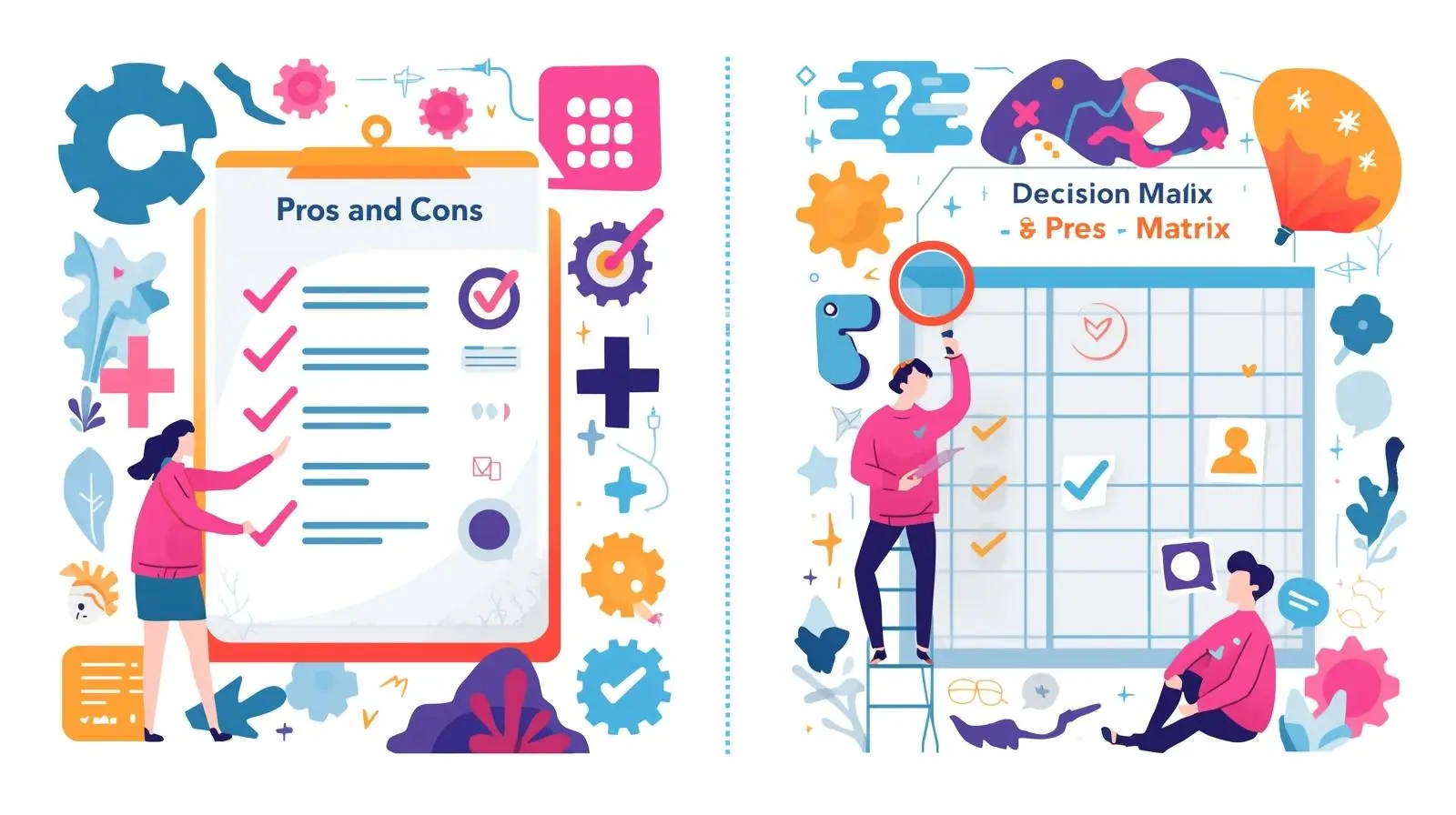
Difficult decision framework
5-step decision making framework
Stuck at a crossroads? Whether it’s choosing between job offers, making a significant purchase, or deciding on a major life change, tough decisions can leave us feeling paralyzed. The anxiety comes from the fear of making the wrong choice.
The good news is that decision-making is a skill you can improve. By moving from emotion-driven reactions to a structured, visual process, you can gain clarity and confidence.
In this guide, I’ll walk you through a simple, powerful 5-step decision-making framework. I’ll also show you how interactive tools from SmartDecisionsHub.com can turn this theoretical framework into a clear, actionable plan and complete with visual aids to see your best path forward.
Why Our Brains Need Help with Hard Choices
When faced with complexity, our minds struggle to hold and objectively compare all the variables. We suffer from cognitive biases, get overwhelmed by “analysis paralysis,” and default to gut feelings that may be based on stress, not facts.
A structured framework acts as an “external brain.” It gets the details out of your head and onto the screen, reduces bias by forcing you to define your criteria, and provides a rational basis for your final call. Let’s build that framework.
The 5-Step Decision-Making Framework
Step 1: Define the Decision & Your Goal
Action: Write down the exact decision you need to make in one clear sentence.
Ask: “What is the specific outcome I want? What does success look like?”
Visual Aid Tip: Use a blank note-taking space. Simply articulating the problem is half the battle.
Example: “Decision: Should I accept the marketing manager role at Company A or the senior specialist role at Company B? Goal: Choose the position that offers the best balance of career growth, compensation, and work-life balance for the next 3-5 years.”
Step 2: Gather Information & List Your Options
Action: Research and list all possible courses of action. Don’t censor yourself in this brainstorming phase. Include the “status quo” as an option if it’s relevant.
Ask: “What are all my possible paths? Have I sought out objective data and diverse perspectives?”
Visual Aid Tip: Create a simple list. Our Free Pros and Cons List Maker is perfect for this initial brain dump. It helps you capture every option and the raw data for each without pressure.
Step 3: Weigh Your Criteria
This is the most critical and often skipped step. Not all factors are equally important.
Action: List the factors that matter for this decision (e.g., salary, commute time, learning opportunity, company culture). Then, assign a weight to each (e.g., on a scale of 1-5 or 1-10) based on its importance to your goal from Step 1.
Ask: “What truly matters to me here? Is salary twice as important as commute? Is growth potential the top priority?”
Visual Aid Tip: This is where a matrix shines. See the section below for how our specialized tool transforms this step.
Step 4: Evaluate and Compare Your Options
Action: Systematically score each option (from Step 2) against each weighted criterion (from Step 3).
Ask: How does Option A perform on Criterion X? Be as objective as possible.
Visual Aid Tip: You need a structured comparison table. Manually doing this math is error-prone. An automated tool calculates the weighted scores instantly, giving you a clear, visual leaderboard. This is the core function of our Weighted Decision Matrix Tool (https://www.smartdecisionshub.com/tools/decision-matrix).
Step 5: Decide, Act, and Review
Action: Based on the visual output from Step 4, make your preliminary decision. Sit with it for a day. Does it feel right alongside the data? If so, commit to an action plan.
Ask: “Given the analysis, which option best serves my goal? What’s the first step to implement it? In 6 months, what will I look back on to see if this was the right choice?”
Visual Aid Tip: Use your results page as a reference. You can revisit it later to review your decision, which helps you learn and refine your criteria for next time.
From Framework to Action: How Our Tools Visualize Your Decision
Let’s make this concrete. Imagine you’re deciding between three apartment rentals.
Step 2: You list your options: Apartment A, Apartment B, Apartment C.
Step 3: You define and weigh your criteria:
- Rent Cost: Importance: 10
- Commute to Work: importance: 8
- Neighborhood Safety: Importance:
- Amenities (laundry, gym): Importance: 5
Here’s the magic of visualization. Instead of a messy list in your head, our Weighted Decision Matrix creates this clear table for you:
(Insert a simple, clean screenshot of your tool interface here, with hypothetical data for the apartment example filled in. Show the final scores highlighting a winner.)
What you see instantly:
- A clean, side-by-side comparison.
- The weighted scores calculated automatically.
- A visual result bar or total score clearly showing which option leads based on your priorities.
The “aha!” moment comes from seeing the result of your own logic. It often confirms a gut feeling or, powerfully, reveals a counter-intuitive winner because the tool honors your stated weights over fleeting emotions.
Ready to visualize your tough choice? Click here to launch the Interactive Weighted Decision Matrix (https://www.smartdecisionshub.com/tools/decision-matrix) and follow the 5 steps directly in the tool. It’s free and requires no sign-up.
What if the "winner" from the tool doesn't feel right?
The tool’s output is a guide, not a dictator. If your intuition strongly objects, revisit your criteria and weights. Did you miss an emotional or personal factor? Add it in and recalculate. The goal is informed alignment between your head and heart.
Is this overkill for small decisions?
Absolutely. Use this full framework for major life, career, or financial decisions. For smaller ones, a quick Pros and Cons List Maker is often sufficient.
Can I use this for business decisions?
Yes! This framework is the basis for professional models like SWOT analysis and multi-criteria decision analysis (MCDA).
Conclusion: Clarity Through Structure
Making a difficult decision doesn’t have to mean agonizing in uncertainty. By following a structured framework and leveraging visual tools, you transform a murky problem into a mapped-out landscape. You move from asking “What should I do?” to confidently stating “Here’s why I’m doing this.”
Your Next Step: Don’t just read about it’s experience the clarity.
- Bookmark this page to return to the 5-step framework.
- Go to our Free Decision-Making Tools Hub (https://www.smartdecisionshub.com/tools)** to choose the right tool for your current challenge.
- Start with the Weighted Decision Matrix (https://www.smartdecisionshub.com/tools/decision-matrix) Its the most powerful way to implement everything you’ve just learned.