
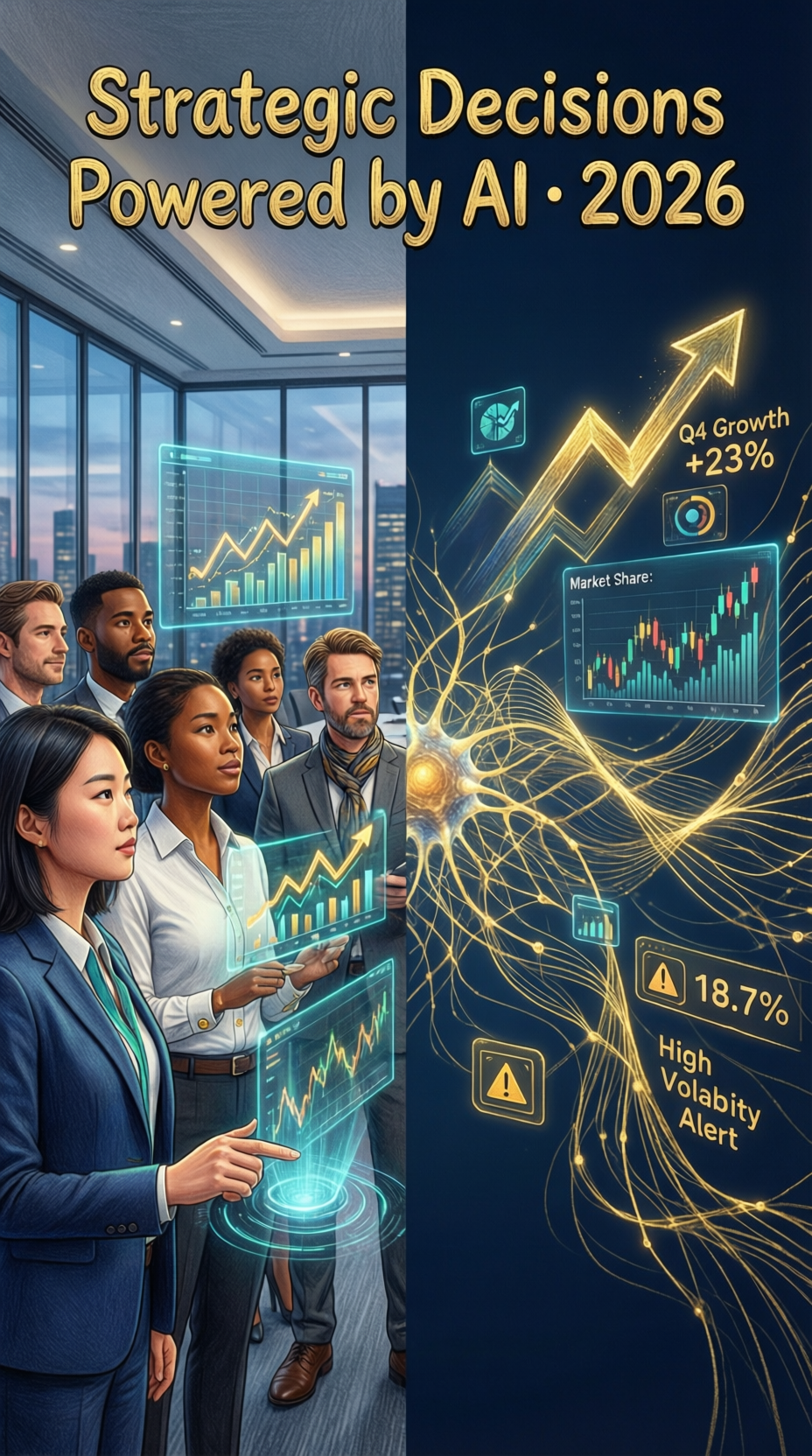
Introduction: The AI-Powered Decision Revolution
In 2026, strategic decision-making has evolved beyond gut instinct and static spreadsheets. Companies leveraging AI tools for strategic decisions are outperforming competitors by 37% in revenue growth and reducing decision latency by up to 68%.
chatfin.ai
The most successful organizations now deploy integrated AI systems that don’t just analyze data—they interpret context, simulate outcomes, and recommend actionable strategies in real time.
This guide explores the essential AI tools reshaping corporate strategy this year, with practical implementation insights for leaders ready to transform uncertainty into advantage.
1. Augmented Business Intelligence Platforms
Modern BI tools have transcended dashboards to become conversational strategic partners:
- Microsoft Power BI + Copilot: Ask natural language questions like “Show me market share risks if Competitor X launches Product Y in Q3” and receive narrative insights with recommended actions.
- Tableau + Einstein Discovery: Automatically surfaces hidden correlations between operational metrics and strategic outcomes, flagging opportunities competitors miss.
- Sigma Computing: Enables business analysts (not just data scientists) to build complex predictive models through intuitive interfaces—democratizing strategic analytics.
SEO Keywords: AI business intelligence tools 2026, augmented analytics platforms, natural language BI
2. Predictive Analytics & Simulation Engines
Forward-looking companies use these tools to stress-test strategies before commitment:
- Dataiku: Unifies data preparation, machine learning, and deployment in one workflow—critical for scenario planning across supply chain disruptions or market shifts.
- H2O.ai Driverless AI: Automates feature engineering and model selection to forecast market trends with 92%+ accuracy for Fortune 500 clients.
- Alteryx AI Platform: Combines spatial analytics with predictive modeling to optimize geographic expansion strategies and site selection.
Pro Tip: Pair these tools with external data streams (economic indicators, social sentiment, regulatory changes) to avoid “inside-the-building” bias in forecasts.
SEO Keywords: predictive analytics tools 2026, strategic scenario planning AI, enterprise forecasting platforms
3. AI Decision Intelligence Platforms
The emerging category transforming how executives evaluate complex trade-offs:
- NexStrat AI: Cuts strategy development timelines from weeks to days by mapping competitive landscapes, simulating moves/countermoves, and quantifying risk exposure.
- Domo Decision Intelligence: Connects real-time operational data with strategic KPIs, alerting leaders when execution drifts from intended outcomes.
- Raven Labs Ethical AI Governance: Monitors algorithm behavior to flag biased recommendations—essential for maintaining stakeholder trust in AI-driven decisions.
SEO Keywords: AI decision intelligence 2026, strategic simulation tools, ethical AI governance
4. Generative AI for Strategic Synthesis
Beyond content creation, GenAI now synthesizes fragmented intelligence into coherent strategy:
- Perplexity Enterprise: Researches market shifts, competitor moves, and regulatory changes across 200+ sources—delivering executive briefings with source-tracked citations.
- AlphaMatch Curiosity: Answers complex strategic questions by connecting internal data with external market intelligence in natural language.
- Custom LLMs (Fine-tuned): Leading firms deploy proprietary models trained on decades of internal strategy documents, M&A outcomes, and post-mortems to avoid repeating historical mistakes.
Critical Implementation Note: Always maintain human-in-the-loop validation. AI generates hypotheses; executives own judgment calls.
SEO Keywords: generative AI strategy tools, competitive intelligence AI, executive decision support
5. AI Agents for Continuous Strategy Execution
The 2026 breakthrough: autonomous agents that monitor execution and adjust tactics without human intervention:
- Multi-agent orchestration platforms (e.g., SuperAGI ecosystem) deploy specialized AI agents that:
- Monitor market signals 24/7
- Trigger tactical pivots when predefined thresholds are breached
- Report strategic drift to leadership with root-cause analysis
These systems transform strategy from annual documents into living, adaptive frameworks.
Implementation Roadmap: Start Smart in 2026
- Audit decision latency: Map your top 5 strategic decisions—how long do they take? Where do bottlenecks exist?
- Pilot one high-impact use case: Customer churn prediction or pricing optimization delivers fastest ROI.
- Demand explainability: Reject “black box” tools. You must understand why AI recommends a specific strategic move.
- Build cross-functional teams: Blend data scientists, domain experts, and ethicists to govern AI decisions responsibly.
- Measure strategic agility: Track reduction in time-to-decision and improvement in outcome accuracy quarter-over-quarter.
The Bottom Line
AI tools for strategic decisions in 2026 aren’t about replacing executives—they’re about augmenting human judgment with unprecedented speed, scale, and foresight. Companies that treat AI as a collaborative intelligence partner (not a magic button) will navigate volatility with confidence while competitors remain reactive.
The question is no longer if to adopt AI for strategy—but how quickly you can integrate these tools ethically and effectively before disruption finds you first.