
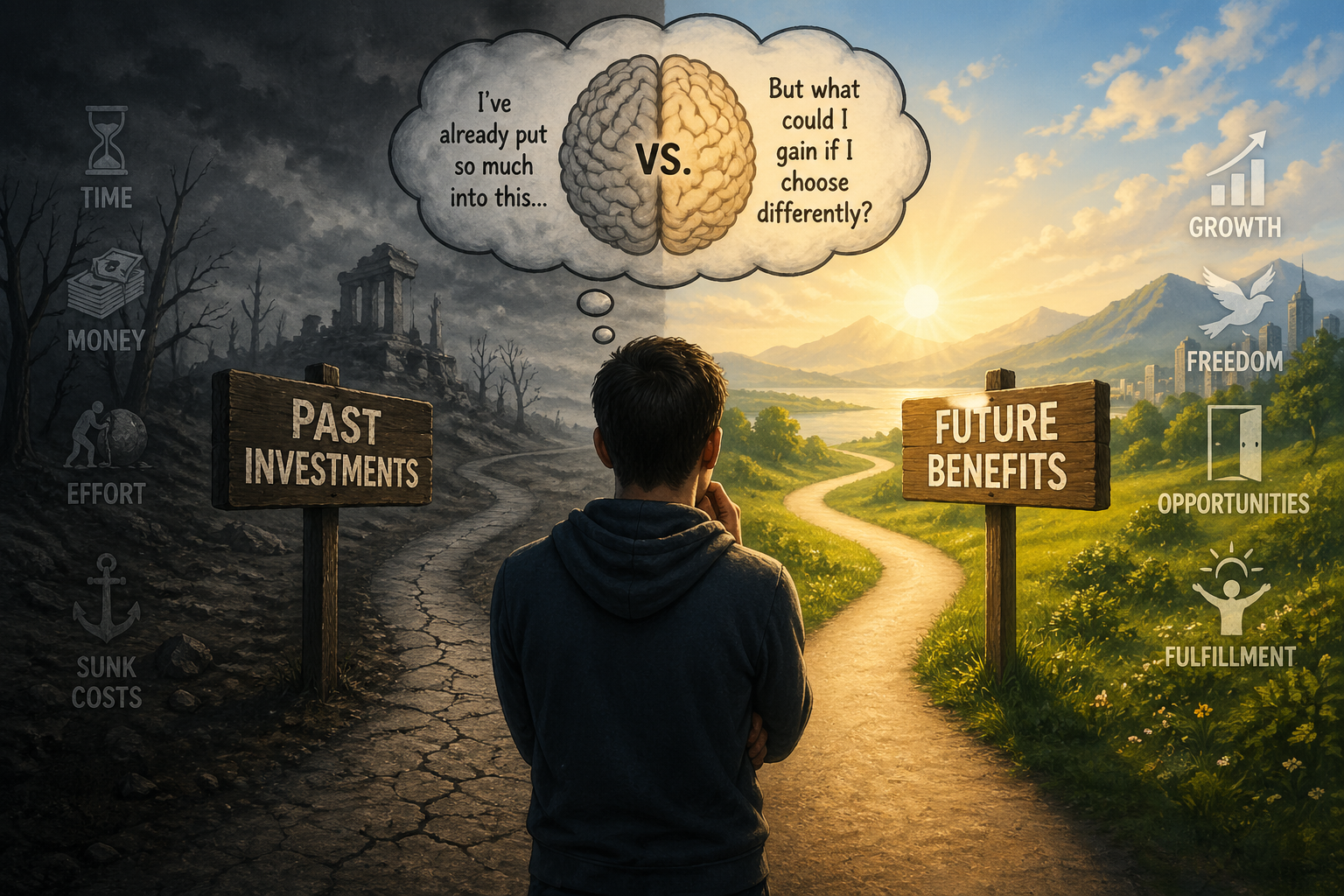
Have you ever finished a terrible movie just because you paid for the ticket? Or continued a failing project because you’ve already invested so much time and money? If so, you’ve fallen victim to the sunk cost fallacy—one of the most pervasive cognitive biases affecting our decision-making today.
Understanding the psychology of sunk cost fallacy is crucial for making rational, forward-thinking decisions in both your personal and professional life. Let’s explore why we cling to losing investments and how to break free from this mental trap.
What Is the Sunk Cost Fallacy?
The sunk cost fallacy (also known as sunk cost bias) occurs when we continue a behavior or endeavor because of previously invested resources—time, money, or effort—rather than evaluating the current situation objectively. These past investments are “sunk costs” because they cannot be recovered, yet they irrationally influence our future decisions.
The Classic Definition
In behavioral economics, a sunk cost is any cost that has already been incurred and cannot be recovered. The fallacy arises when we factor these irrecoverable costs into our decision-making process, leading to irrational behavior and poor outcomes.
The Psychology Behind Sunk Cost Fallacy
Why do intelligent, rational people fall prey to this decision-making error? The psychology of sunk cost fallacy reveals several underlying mechanisms:
1. Loss Aversion
Humans feel the pain of loss more intensely than the pleasure of gain. Admitting that our past investment was wasted triggers this psychological discomfort, so we throw good resources after bad to avoid facing the loss.
2. Emotional Attachment
We develop emotional decision making patterns around our investments. The more time, money, or effort we’ve poured into something, the more emotionally invested we become, clouding our judgment.
3. Commitment and Consistency Bias
Once we’ve made a public commitment or taken a stance, we feel psychological pressure to remain consistent—even when circumstances change. This desire for consistency overrides logical cost-benefit analysis.
4. Fear of Wasting Resources
The thought of “wasting” our previous investment feels unacceptable. We’d rather continue investing in a failing venture than accept that those resources are gone forever.
5. Ego and Self-Justification
Admitting a mistake threatens our self-image. We continue down the wrong path to prove—to ourselves and others—that our original decision was correct.
Real-World Examples of Sunk Cost Fallacy
Personal Life Examples
- Relationships: Staying in an unhealthy relationship because “we’ve been together for five years”
- Education: Completing a degree you no longer want because you’ve already paid tuition and completed two years
- Entertainment: Finishing a book or movie you dislike because you’ve already started it
- Fitness: Continuing with a gym membership you never use because you paid for a year upfront
Business Examples
- Projects: Continuing a failing software development project because millions have already been spent
- Marketing: Persisting with an ineffective advertising campaign because of the initial investment
- Hiring: Keeping an underperforming employee because of the training resources invested
- Products: Continuing to manufacture a product with declining demand due to equipment costs
The Cost of Sunk Cost Fallacy
Falling prey to sunk cost bias has serious consequences:
- Financial Losses: Throwing good money after bad
- Opportunity Costs: Missing better alternatives while clinging to failing ventures
- Emotional Toll: Stress, anxiety, and regret from prolonged poor decisions
- Time Wasted: Years spent on paths that don’t serve your goals
- Stagnation: Preventing personal and professional growth
How to Overcome the Sunk Cost Fallacy
Breaking free from this cognitive bias requires conscious effort and practical strategies:
1. Recognize Sunk Costs for What They Are
Acknowledge that past investments are gone forever. They should not factor into your current decision-making equation. Ask yourself: “If I weren’t already invested, would I start this today?”
2. Focus on Future Value, Not Past Investment
Shift your perspective to rational decision making by evaluating only future costs and benefits. What will this decision cost going forward? What benefits will it provide? Ignore what’s already spent.
3. Set Pre-Defined Exit Criteria
Before starting any significant investment, establish clear metrics for success and failure. Define in advance:
- Budget limits
- Timeline milestones
- Performance indicators
- Exit triggers
This removes emotion from the decision when it’s time to evaluate.
4. Seek External Perspectives
We’re often blind to our own decision-making errors. Consult trusted advisors, mentors, or colleagues who aren’t emotionally invested. They can provide objective cost-benefit analysis without the bias.
5. Reframe “Waste” as Learning
Instead of viewing past investments as wasted, reframe them as tuition for valuable lessons. This mindset shift reduces the emotional burden and makes it easier to cut losses.
6. Practice Regular Decision Audits
Schedule periodic reviews of your ongoing commitments—projects, relationships, investments, subscriptions. Ask: “Is this still serving my goals?” rather than “How much have I invested?”
7. Embrace the Sunk Cost Fallacy in Reverse
Use this bias to your advantage by making small initial investments. Once you’ve started something (even minimally), you’re more likely to continue. This works for building positive habits like exercise or learning new skills.
8. Calculate Opportunity Costs
For every hour or dollar you continue investing, ask: “What else could I do with this resource?” Often, the alternative uses are far more valuable than continuing down a failing path.
The Role of Emotional Intelligence
Overcoming sunk cost fallacy psychology isn’t just about logic—it requires emotional intelligence. You must:
- Acknowledge your feelings about past investments
- Separate identity from decisions (a bad decision doesn’t make you a failure)
- Practice self-compassion when cutting losses
- Develop comfort with uncertainty and change
Sunk Cost Fallacy vs. Related Cognitive Biases
Understanding how sunk cost fallacy relates to other cognitive biases helps you recognize patterns:
- Escalation of Commitment: Doubling down on failing courses of action
- Confirmation Bias: Seeking information that justifies past decisions
- Status Quo Bias: Preferring to maintain current situations
- Endowment Effect: Valuing things more highly simply because we own them
These biases often work together, creating powerful psychological traps that derail rational decision making.
Building Better Decision-Making Habits
To make the psychology of sunk cost fallacy work for you rather than against you:
Create Decision-Making Frameworks
Develop systematic approaches to evaluating choices that explicitly exclude sunk costs. Use decision matrices, pros/cons lists, or the 10-10-10 rule (how will I feel about this in 10 minutes, 10 months, 10 years?).
Practice Mindfulness
Emotional decision making often happens on autopilot. Mindfulness practices help you pause, recognize when biases are influencing you, and choose more deliberately.
Celebrate Smart Exits
Reframe quitting as a strategic decision, not a failure. Celebrate when you cut losses wisely—this rewires your brain to see it as strength, not weakness.
Document Your Decisions
Keep a decision journal recording:
- What you decided and why
- What information you had at the time
- What you expected to happen
- What actually happened
This builds self-awareness and improves future decision-making accuracy.
When Persistence Is Actually Wise
Not all persistence is sunk cost fallacy. Sometimes sticking with something difficult is the right choice. How do you know the difference?
Healthy Persistence:
- Based on future potential and evidence of progress
- Aligned with long-term values and goals
- Adjusts strategy based on feedback
- Has clear milestones and evaluation points
Sunk Cost Fallacy:
- Based primarily on past investment
- Ignores negative feedback and warning signs
- Continues despite no evidence of improvement
- Motivated by fear, pride, or avoidance
The key is honest evaluation of future prospects, not justification of past choices.
The Bottom Line
The psychology of sunk cost fallacy reveals a fundamental truth about human nature: we’re not naturally rational decision-makers. Our emotions, ego, and cognitive biases constantly pull us toward irrational behavior.
But awareness is power. By understanding how sunk cost bias operates, recognizing it in your own life, and implementing practical strategies to overcome it, you can make clearer, more rational choices.
Remember: Your past investments don’t determine your future value. The resources you’ve already spent are gone. What matters is how you use the resources you have now to create the best possible future.
The courage to walk away from sunk costs isn’t weakness—it’s wisdom. It’s the foundation of rational decision making and the key to unlocking better outcomes in every area of your life.
Ready to make better decisions? Start by identifying one area where sunk cost fallacy might be holding you back. Apply these principles today, and take your first step toward clearer, more rational decision-making.