
Introduction
In today’s fast-paced business environment, the pressure to make the right call can be overwhelming. Whether you are choosing a new software vendor, pivoting your content strategy, or planning your next career move, decision fatigue is a very real threat.
While advanced AI tools and complex business intelligence platforms get all the hype, one of the most powerful tools for spreadsheet decision making is likely already open on your computer. Spreadsheets are not just for accountants; they are highly adaptable frameworks for structured thinking.
Here are 7 ways you can leverage a simple spreadsheet to cut through the noise, align your team, and make better decisions with confidence.
1. Centralize Data to Eliminate Guesswork
When decisions are made based on scattered emails, Slack messages, and mental notes, errors are inevitable. A spreadsheet forces you to centralize all relevant criteria, options, and data points into a single source of truth. By laying out your variables clearly, you shift from reactive guessing to proactive, data-driven decision making.
2. Build a Weighted Decision Matrix
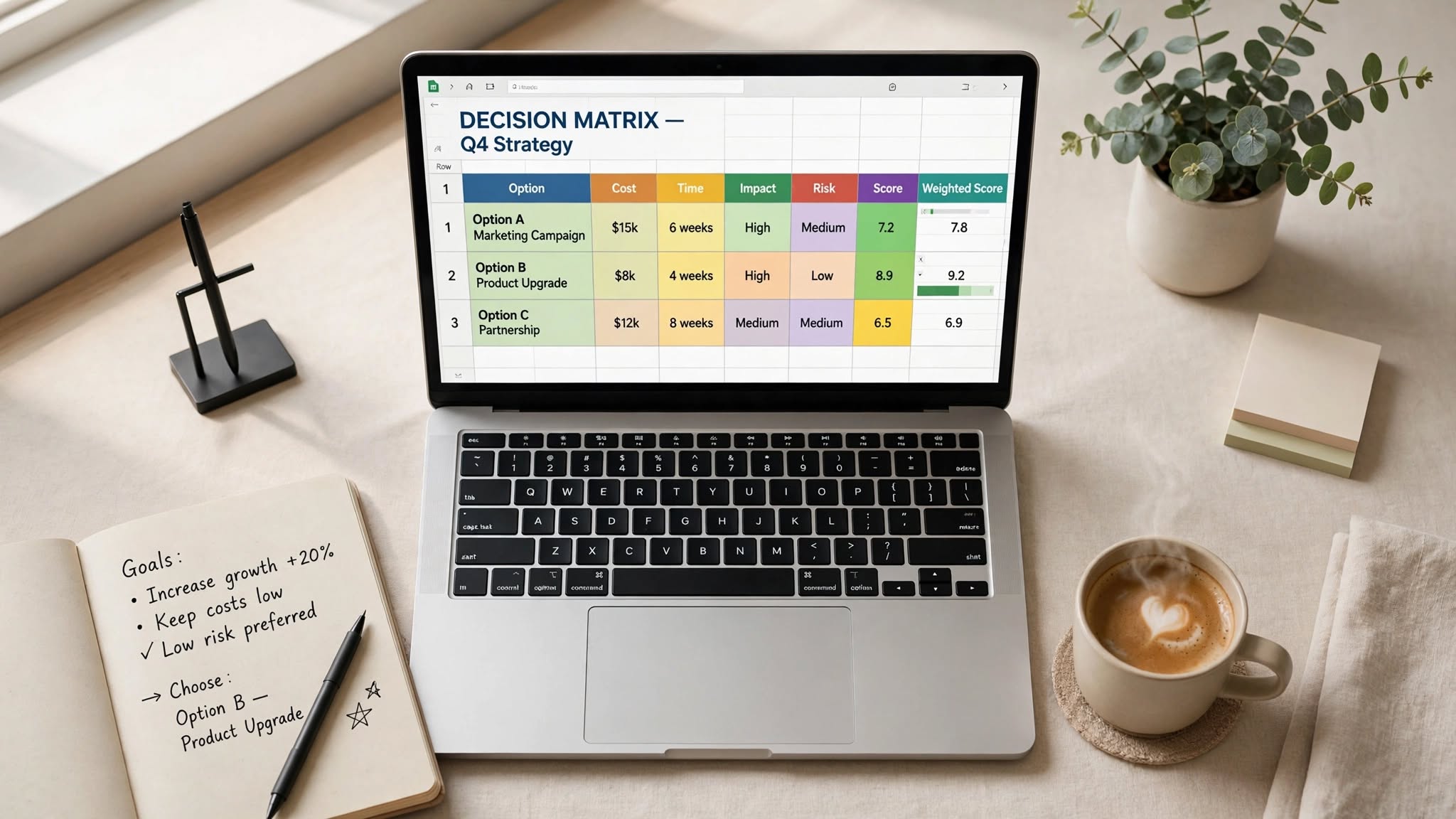
Not all factors are created equal. A weighted decision matrix in a spreadsheet allows you to assign importance scores (e.g., 1–5) to different criteria like cost, time, and ROI. By multiplying the weight by the score for each option, the spreadsheet calculates an objective total, removing emotional bias from the equation. (Pro tip: Pair this structured approach with insights from our Case Study: How ChatGPT Can Improve Business Decision Making to generate your initial criteria faster).
3. Model “What-If” Scenarios Without Real-World Risk
Strategic planning requires foresight. Spreadsheets excel at scenario modeling. By changing a few input variables (like a 10% increase in marketing budget or a 2-month delay in development), you can instantly see the projected impact on your outcome. This allows you to stress-test your choices before committing real resources.
4. Track Historical Decisions to Identify Patterns
A spreadsheet can serve as a “Decision Journal.” By logging the date, the decision made, the expected outcome, and the actual result, you create a valuable historical record. Over time, reviewing this log helps you identify cognitive biases or recurring blind spots, continuously refining your ability to make better decisions in the future.
5. Align Cross-Functional Teams
One of the biggest challenges in business is bridging the gap between technical and marketing professionals. A shared spreadsheet acts as a universal translator. When both developers and marketers contribute to the same prioritization framework, it fosters transparency, reduces friction, and ensures everyone is aligned on the “why” behind a decision.
6. Automate Routine Calculations to Reduce Cognitive Load
Decision fatigue sets in when you waste mental energy on repetitive math. By setting up simple formulas (like
SUM, AVERAGE, or IF statements), you automate the heavy lifting. This frees up your brain to focus on high-level strategy rather than manual calculations. If you want to further optimize your daily mental bandwidth, consider exploring How to Build a Morning Decision Routine to start your day with clarity.7. Visualize Data for Faster Stakeholder Buy-In
Numbers alone rarely persuade stakeholders. Spreadsheets allow you to instantly convert your data into bar charts, pie graphs, or conditional formatting (like red/yellow/green status indicators). A clear visual representation makes your rationale undeniable and speeds up the approval process.
Conclusion
You don’t need a million-dollar enterprise system to make better decisions. You just need a structured approach. By leveraging spreadsheet decision making, you can centralize your data, remove emotional bias, and model the future with confidence.
Start small: pick one upcoming decision this week and build a simple matrix. As your needs grow, you can even integrate these structured frameworks with advanced tools. For leaders looking to scale their strategic planning, our guide on The 2027 AI Architect: How SME Managers Can Design an AI Strategy offers a practical roadmap for the future .
smartdecisionshub.com
What’s your favorite spreadsheet hack for making tough choices? Share it in the comments below, or explore our free Decision Making Tools to keep your strategic mindset sharp.