
Introduction
Every day, we face decisions—some small, others life-changing. Whether you’re a business leader evaluating a new project, a professional considering a career change, or an individual weighing a major purchase, the question remains the same: Is it worth it?
This is where cost-benefit analysis (CBA) becomes your most powerful decision-making ally. In this comprehensive guide, we’ll explore the art and science of cost-benefit analysis, providing you with practical frameworks, real-world applications, and tools to make smarter, data-driven decisions.
What Is Cost-Benefit Analysis?
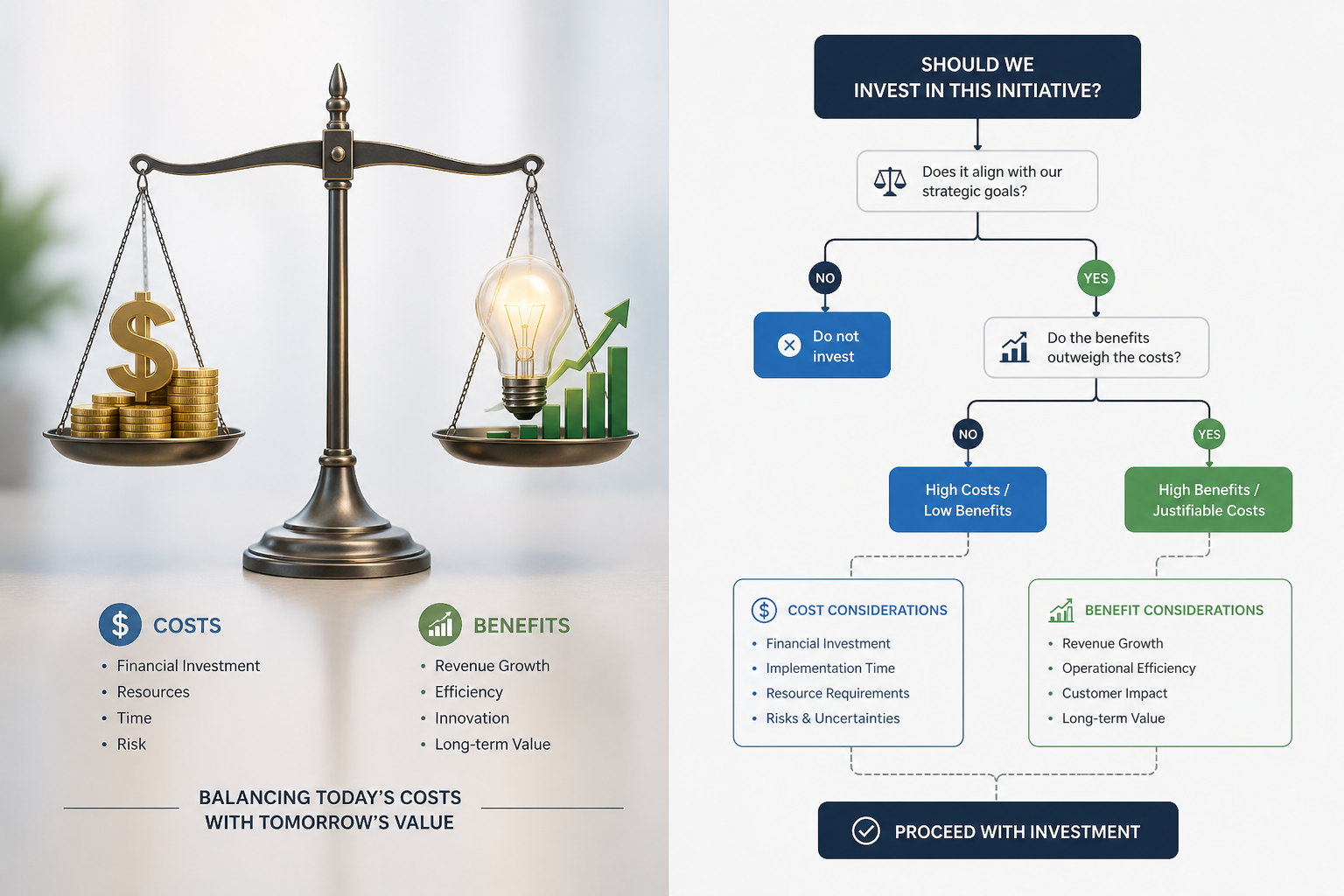
Cost-benefit analysis is a systematic approach to estimating the strengths and weaknesses of alternatives. It’s used to determine options that provide the best approach to achieve benefits while preserving savings in activities, functions, or business processes.
At its core, CBA involves:
- Identifying all costs associated with a decision
- Quantifying all benefits expected from that decision
- Comparing the two to determine if the benefits outweigh the costs
- Making an informed choice based on data rather than intuition
Why Cost-Benefit Analysis Matters
1. Removes Emotional Bias
Emotions can cloud judgment. A structured CBA framework forces you to look at facts and figures objectively.
2. Provides Clear ROI Perspective
Understanding the return on investment helps prioritize projects and initiatives. Our ROI/ROAS Calculator can help you quantify these returns effectively .
smartdecisionshub.com
3. Enhances Strategic Planning
CBA aligns decisions with long-term goals and objectives. Consider using our OKR Board to track how your decisions support your key results .
smartdecisionshub.com
4. Improves Resource Allocation
Limited resources demand smart allocation. Cost-benefit analysis ensures you’re investing time, money, and effort where they’ll have the most impact.
5. Facilitates Stakeholder Buy-In
Data-driven decisions are easier to defend and explain to stakeholders, team members, or family.
The Cost-Benefit Analysis Framework: Step-by-Step
Step 1: Define Your Decision Clearly
Start with a specific, well-defined question. Instead of “Should we expand?” ask “Should we open a new office in Austin, Texas, with a budget of $500,000?”
Step 2: Identify All Costs
Costs fall into several categories:
Direct Costs:
- Initial investment/purchase price
- Implementation expenses
- Training costs
- Equipment and materials
Indirect Costs:
- Time investment
- Opportunity costs (what you’re giving up)
- Maintenance and support
- Potential risks and downsides
Intangible Costs:
- Employee morale impact
- Brand reputation effects
- Customer satisfaction changes
Step 3: Identify All Benefits
Benefits also come in various forms:
Tangible Benefits:
- Revenue increases
- Cost savings
- Productivity improvements
- Time savings
Intangible Benefits:
- Improved customer satisfaction
- Enhanced brand reputation
- Better employee engagement
- Strategic positioning
Step 4: Assign Monetary Values
This is where many people struggle. How do you put a dollar value on employee satisfaction or brand reputation?
Tips for Valuation:
- Use market research and industry benchmarks
- Consult historical data
- Apply proxy values (e.g., cost of hiring replacement employees for morale issues)
- Use surveys and willingness-to-pay studies
- Don’t ignore intangibles—estimate conservatively
Step 5: Calculate and Compare
The basic formula:
Net Benefit = Total Benefits – Total Costs
Benefit-Cost Ratio (BCR) = Total Benefits / Total Costs
- BCR > 1: Benefits outweigh costs (favorable)
- BCR < 1: Costs outweigh benefits (unfavorable)
- BCR = 1: Break-even point
For more complex financial decisions, use our Loan Calculator to understand long-term financial implications .
smartdecisionshub.com
Step 6: Factor in Time Value of Money
Money today is worth more than money tomorrow. For long-term projects, calculate:
- Net Present Value (NPV)
- Internal Rate of Return (IRR)
- Payback Period
Step 7: Conduct Sensitivity Analysis
Test your assumptions:
- What if costs are 20% higher?
- What if benefits take twice as long to materialize?
- What are the best-case and worst-case scenarios?
Step 8: Make Your Decision
Based on your analysis, decide whether to:
- Proceed with the decision
- Modify the approach
- Seek alternatives
- Abandon the idea
Cost-Benefit Analysis Tools and Techniques
1. Decision Matrix
A decision matrix helps you evaluate multiple options against weighted criteria. Try our interactive Decision Matrix tool to compare alternatives systematically .
smartdecisionshub.com
2. SWOT Analysis
Before diving into numbers, understand the strategic landscape. Our SWOT Analysis tool helps identify Strengths, Weaknesses, Opportunities, and Threats .
smartdecisionshub.com
3. Random Decision Tools
Sometimes you need to break analysis paralysis. Our Random Wheel can help when options are equally viable .
smartdecisionshub.com
4. Financial Calculators
Use specialized calculators for specific scenarios:
- ROI/ROAS Calculator for marketing investments smartdecisionshub.com
- BMI Calculator for health-related decisions smartdecisionshub.com
- Loan calculators for financing decisions
Real-World Cost-Benefit Analysis Examples
Example 1: Business Software Implementation
Scenario: A company considers implementing new project management software.
Costs:
- Software licenses: $10,000/year
- Training: $5,000 (one-time)
- Implementation time: $15,000 (employee hours)
- Total Year 1 Costs: $30,000
Benefits:
- Time savings: $25,000/year
- Reduced errors: $10,000/year
- Improved client satisfaction: $8,000/year (estimated)
- Total Annual Benefits: $43,000
Analysis:
- Year 1 Net Benefit: $43,000 – $30,000 = $13,000
- Year 2+ Net Benefit: $43,000 – $10,000 = $33,000/year
- BCR (Year 1): 1.43
- Decision: Proceed (positive ROI after Year 1)
Example 2: Personal Decision—Returning to School
Scenario: Considering an MBA program.
Costs:
- Tuition: $60,000
- Lost income (2 years): $100,000
- Books and fees: $5,000
- Total Costs: $165,000
Benefits:
- Salary increase: $30,000/year
- Career advancement opportunities: Priceless but significant
- Network value: Difficult to quantify
- Annual Benefit: $30,000+
Analysis:
- Payback Period: ~5.5 years
- 10-year net benefit: $300,000 – $165,000 = $135,000
- Decision: Depends on career goals and risk tolerance
Common Cost-Benefit Analysis Mistakes to Avoid
1. Ignoring Intangible Factors
Don’t focus solely on what’s easily quantifiable. Employee morale, brand reputation, and customer loyalty matter.
2. Confirmation Bias
Don’t manipulate numbers to support a predetermined conclusion. Be honest and objective.
3. Underestimating Costs
Always include a contingency buffer (typically 10-20%) for unexpected expenses.
4. Overestimating Benefits
Be conservative in your benefit projections. It’s better to exceed expectations than fall short.
5. Forgetting Opportunity Costs
What are you giving up by choosing this option? Always consider alternatives.
6. Neglecting Time Horizon
Short-term costs might yield long-term benefits. Ensure your analysis period is appropriate.
7. Analysis Paralysis
Don’t let perfect be the enemy of good. Sometimes a “good enough” analysis is better than no decision.
Advanced Cost-Benefit Analysis Techniques
1. Multi-Criteria Decision Analysis (MCDA)
When decisions involve multiple, often conflicting objectives, MCDA provides a structured approach to evaluate trade-offs.
2. Risk-Adjusted CBA
Incorporate probability assessments:
- Expected Value = (Benefit × Probability) – (Cost × Probability)
3. Scenario Planning
Develop multiple scenarios:
- Best case
- Most likely case
- Worst case
This helps understand the range of possible outcomes.
4. Real Options Analysis
For complex, multi-stage decisions, real options analysis values the flexibility to adapt as circumstances change.
Cost-Benefit Analysis in Different Contexts
Business Decisions
- Capital investments
- New product development
- Market expansion
- Hiring decisions
- Technology adoption
Use our ROI/ROAS Calculator to evaluate marketing and investment decisions with precision .
smartdecisionshub.com
Personal Finance
- Major purchases (home, car)
- Investment decisions
- Debt consolidation
- Insurance choices
Career Decisions
- Job offers
- Career changes
- Professional development
- Relocation
Public Policy
- Infrastructure projects
- Environmental regulations
- Healthcare initiatives
- Education programs
Integrating CBA with Other Decision-Making Tools
Cost-benefit analysis works best when combined with other frameworks:
1. SWOT Analysis
Start with SWOT to understand the strategic context before quantifying costs and benefits.
2. Decision Matrix
Use a decision matrix when comparing multiple alternatives with various criteria.
3. OKR Framework
Align your CBA with Objectives and Key Results using our OKR Board to ensure decisions support your goals .
smartdecisionshub.com
4. Random Selection Tools
When analysis shows options are nearly equal, use tools like our Random Wheel to make the final choice .
smartdecisionshub.com
5. Inspirational Guidance
Sometimes you need perspective. Check our Random Quotes for wisdom from great decision-makers .
smartdecisionshub.com
Creating Your Cost-Benefit Analysis Template
Here’s a simple template to get started:
Decision: [Clearly state the decision]
Date: [Analysis date]
Time Horizon: [Period for analysis]
Costs:
Category | Description | Amount | Timing |
|---|---|---|---|
Direct | $ | ||
Indirect | $ | ||
Intangible | $ | ||
Total Costs | $ |
Benefits:
Category | Description | Amount | Timing |
|---|---|---|---|
Tangible | $ | ||
Intangible | $ | ||
Total Benefits | $ |
Analysis:
- Net Benefit: $_____
- Benefit-Cost Ratio: _____
- Payback Period: _____
- NPV (if applicable): $_____
Recommendation:
[ ] Proceed [ ] Modify and reanalyze [ ] Seek alternatives [ ] Do not proceed
Confidence Level: [High/Medium/Low]
Key Assumptions:
1. 2. 3.
The Psychology of Cost-Benefit Analysis
Understanding cognitive biases improves your CBA accuracy:
Loss Aversion
We feel losses more strongly than equivalent gains. Counter this by objectively valuing both.
Sunk Cost Fallacy
Past investments shouldn’t influence future decisions. Focus on future costs and benefits only.
Anchoring Bias
Don’t let initial numbers unduly influence your analysis. Research independently.
Availability Heuristic
Don’t overweight recent or memorable events. Use comprehensive data.
When NOT to Use Cost-Benefit Analysis
While powerful, CBA isn’t always appropriate:
- Ethical Decisions: Some choices involve moral imperatives that transcend cost-benefit calculations
- Emergency Situations: When time is critical, rapid decision-making trumps thorough analysis
- Highly Uncertain Environments: When data is unavailable or unreliable, other approaches may be better
- Personal Values: Some decisions are based on principles, not economics
The Future of Cost-Benefit Analysis
Emerging trends are enhancing CBA:
AI and Machine Learning
Predictive analytics improve benefit forecasting and risk assessment.
Big Data
Larger datasets enable more accurate valuations and trend identification.
Behavioral Economics
Better understanding of human behavior improves intangible valuations.
Real-Time Analysis
Cloud-based tools enable dynamic, updatable CBA models.
Your Action Plan: Implementing CBA Today
Week 1: Start small
- Apply CBA to a minor decision
- Use our template above
- Practice identifying all costs and benefits
Week 2: Add complexity
- Tackle a medium-stakes decision
- Incorporate time value of money
- Conduct sensitivity analysis
Week 3: Use technology
- Leverage our ROI/ROAS Calculator for financial decisions smartdecisionshub.com
- Try the Decision Matrix for multi-option scenarios smartdecisionshub.com
- Track your OKRs with our OKR Boardsmartdecisionshub.com
Week 4: Refine and scale
- Review your decisions and outcomes
- Adjust your approach based on results
- Apply CBA to major strategic decisions
Conclusion: Master the Art and Science
Cost-benefit analysis is both an art and a science. The science lies in the rigorous methodology, calculations, and frameworks. The art emerges in assigning values to intangibles, balancing competing priorities, and knowing when to trust the numbers versus when to rely on intuition.
By mastering cost-benefit analysis, you equip yourself with a powerful tool for navigating life’s complex decisions. Whether you’re evaluating a business investment, considering a career change, or making personal financial choices, CBA provides clarity in uncertainty.
Remember: the goal isn’t perfection—it’s better decisions. Each analysis you complete sharpens your skills and improves your judgment.
Ready to make smarter decisions?
- Use our ROI/ROAS Calculator for your next investment decision smartdecisionshub.com
- Explore our Decision Matrix for comparing multiple options smartdecisionshub.com
- Check out our SWOT Analysis tool for strategic planning smartdecisionshub.com
- Get inspired by wisdom from our Random Quotes generator smartdecisionshub.com
Start your cost-benefit analysis today, and transform the way you decide!