
Introduction: The New Strategic Landscape
The year 2026 presents a pivotal moment for business leaders. Executive turnover has declined sharply—high-turnover leadership teams dropped from 43% in 2025 to just 19% in 2026—yet the complexity facing senior leaders continues to intensify. Nearly half of executives now identify AI and emerging technologies as a top development priority, while 28% cite lack of strategic clarity as a primary limiter of effectiveness .
Strategic decision-making has transformed. It’s no longer enough to rely on intuition or traditional planning cycles. Today’s leaders must navigate economic uncertainty, rapid technological change, and increasingly complex operating environments. The Business Model Canvas (BMC) remains an essential tool, but in 2026, it requires a data-driven, AI-integrated approach to deliver real strategic value.
Why the Business Model Canvas Matters More Than Ever
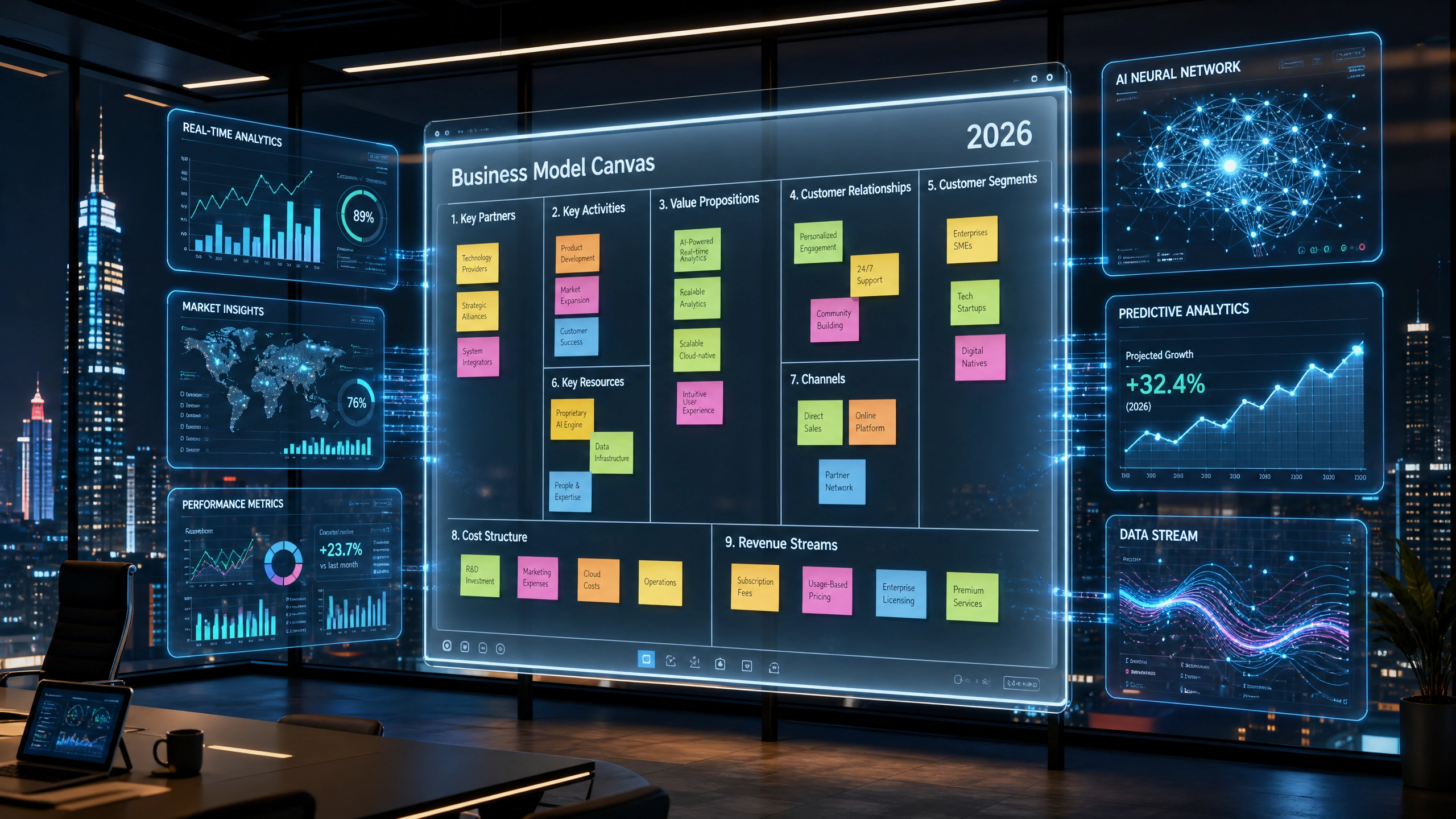
The Business Model Canvas, introduced by Alexander Osterwalder, condenses business logic into nine interconnected building blocks: Key Partners, Key Activities, Key Resources, Value Proposition, Customer Relationships, Channels, Customer Segments, Cost Structure, and Revenue Streams . Its one-page constraint forces strategic clarity—if your team cannot fit its business logic on a single page, the strategy likely isn’t clear enough.
What makes the BMC particularly powerful in 2026 is its ability to reveal weak assumptions and causal links. When leadership teams put their business model on one page, the framework forces visible choices about which customers matter most, what promise earns attention, and which cost drivers threaten viability .
Key Insight: Organizations using the BMC iteratively—testing hypotheses through customer feedback rather than static planning—show a 30% higher survival rate in their first three years compared with those using traditional linear planning .
The Shift from Intuition to Evidence
The transformation in strategic decision-making represents a fundamental shift from traditional “Great Man” theory—rooted in leadership intuition and personal experience—to a 21st-century “Data-First” mandate . As global markets increase in complexity and velocity, reliance on cognitive heuristics and “gut feelings” has become a strategic liability, frequently compromised by systemic biases such as overconfidence and confirmation bias .
Modern strategists are evolving from “visionary gamblers” to “empirical architects.” The ultimate competitive advantage lies in a hybrid synthesis: merging algorithmic precision with uniquely human creative leaps and ethical judgment .
This evolution directly impacts how we fill out the Business Model Canvas. Consider how each block now demands data-driven validation:
| BMC Block | Traditional Approach | 2026 Evidence-Based Approach |
|---|---|---|
| Customer Segments | Broad categories like “SMBs” | Specific segments with validated characteristics |
| Value Proposition | Feature-focused messaging | Customer-validated problem-solution fit |
| Key Resources | Team and capital | Proprietary data, AI capabilities, compliance |
| Revenue Streams | Projected estimates | Customer-validated willingness to pay |
AI-Enhanced Decision Architecture
Artificial intelligence is reshaping how leaders approach strategic decisions. Traditional decision-making explores only a tiny fraction of feasible solutions—senior teams review a handful of scenarios, debate the merits, and rally around a preferred plan .
Swarm intelligence and evolutionary algorithms offer a different approach. Rather than asking, “What is the most likely result?” they ask, “What are all the ways we could win under these constraints?” . These systems treat strategy as a search across a vast landscape of possible configurations, exploring many options simultaneously instead of sequentially .
For Business Model Canvas users, this means:
Key Activities can be optimized through swarm-based exploration
Key Resources can be allocated more efficiently
Revenue Streams can be stress-tested against multiple scenarios
However, swarm intelligence sits inside a broader framework of corporate governance. Poorly designed systems can still optimize the wrong thing very efficiently. Leaders must define meaningful objectives and maintain transparency about how alternatives are evaluated .
Sustainability: The Green Pivot
Sustainability has evolved from a peripheral concern to a core strategic imperative. Business Model Canvas integration now requires explicit consideration of ecological and social impacts .
Dr. Zuraidah Sulaiman, in her 2026 Business Model Class at Universitas Brawijaya, detailed how the Green Pivot transforms every BMC category :
Distribution Channels must evolve toward low-emission logistics and digital platforms
Key Resources should incorporate renewable energy and eco-friendly raw materials
Value Propositions must create products that can be repaired or remanufactured
Revenue Streams can include after-sales services or subscription models instead of single sales
The shift from the traditional 3R principle (Reduce, Reuse, Recycle) to the more comprehensive 9R framework—adding Refuse, Rethink, Repair, Refurbish, Remanufacture, Repurpose, and Recover—reflects the deepening commitment to circular economy principles .
Practical Framework: Running a 2026 Strategy Workshop
To maximize the Business Model Canvas’s strategic value in 2026, treat it as a working session that surfaces assumptions, disagreements, and missing evidence—not a document to complete .
Workshop Flow:
Define the objective. Are you mapping the current business, testing a new venture, or redesigning an existing model?
Bring a cross-functional group. Product, sales, finance, operations, and leadership should all participate.
Start with customers and value. Teams often want to start with resources, but beginning with Customer Segments and Value Propositions forces market-facing discipline .
Move to revenue and costs. This forces economic discipline early in the process.
Map resources, activities, and partners. Only after the promise and monetization logic are visible.
Mark assumptions clearly. Don’t let guesses masquerade as validated facts.
End with the biggest risks. Ask which boxes depend on evidence you don’t yet have.
Pro Tip: Keep strategy and tactics separate. “Run LinkedIn ads” is not a business model—it’s a tactic. “Reach CFOs through direct and partner-led channels” belongs on the canvas because it describes a channel choice at the model level .
Common Mistakes and How to Avoid Them
Most failed canvas work doesn’t fail because the framework is weak. It fails because teams use it as a workshop prop .
| Mistake | What It Looks Like | Better Move |
|---|---|---|
| Filling it out alone | One person completes it in isolation | Use a cross-functional session |
| Writing vague labels | “Consumers,” “innovation,” “marketing” | Use specific segments, offers, and channels |
| Ignoring AI dependencies | Listing codebase without data/model dependencies | Include proprietary data, model providers, compliance |
| Static approach | Canvas never updated | Treat as living document, updated with learning |
2026 Decision-Making Imperatives
The LHH 2026 C-Suite research identifies three interdependent leadership imperatives that directly inform Business Model Canvas application :
1. AI Accountability
AI is now a core executive responsibility, requiring both technical literacy and disciplined decision-making. Your BMC must account for AI capabilities—not just in Key Resources, but across how you understand Customer Segments and deliver Value Propositions.
2. Strategic Clarity
Lack of clarity around strategic objectives remains the top factor limiting leadership success. The BMC’s one-page format is uniquely suited to creating and maintaining this clarity.
3. Succession Readiness
With 58% of late-career executives planning to stay for at least three more years, organizations must build leadership pipelines. The BMC serves as an excellent training tool for developing strategic thinking in next-generation leaders.
Conclusion: The Empowered Strategist
Data and AI do not render the strategist obsolete. Instead, they transform the role from a “visionary gambler” into an “empirical architect” . The strategist of the future must be “bilingual”—capable of merging algorithmic precision with uniquely human creative leaps and ethical judgment.
The Business Model Canvas remains an invaluable tool for this role. It provides a shared surface for argument, forces visible choices, and enables teams to see where the model is inconsistent. When combined with data-driven validation, AI-enhanced exploration, and sustainability principles, the BMC becomes not just a planning tool but a strategic management system for navigating an increasingly unpredictable business landscape.