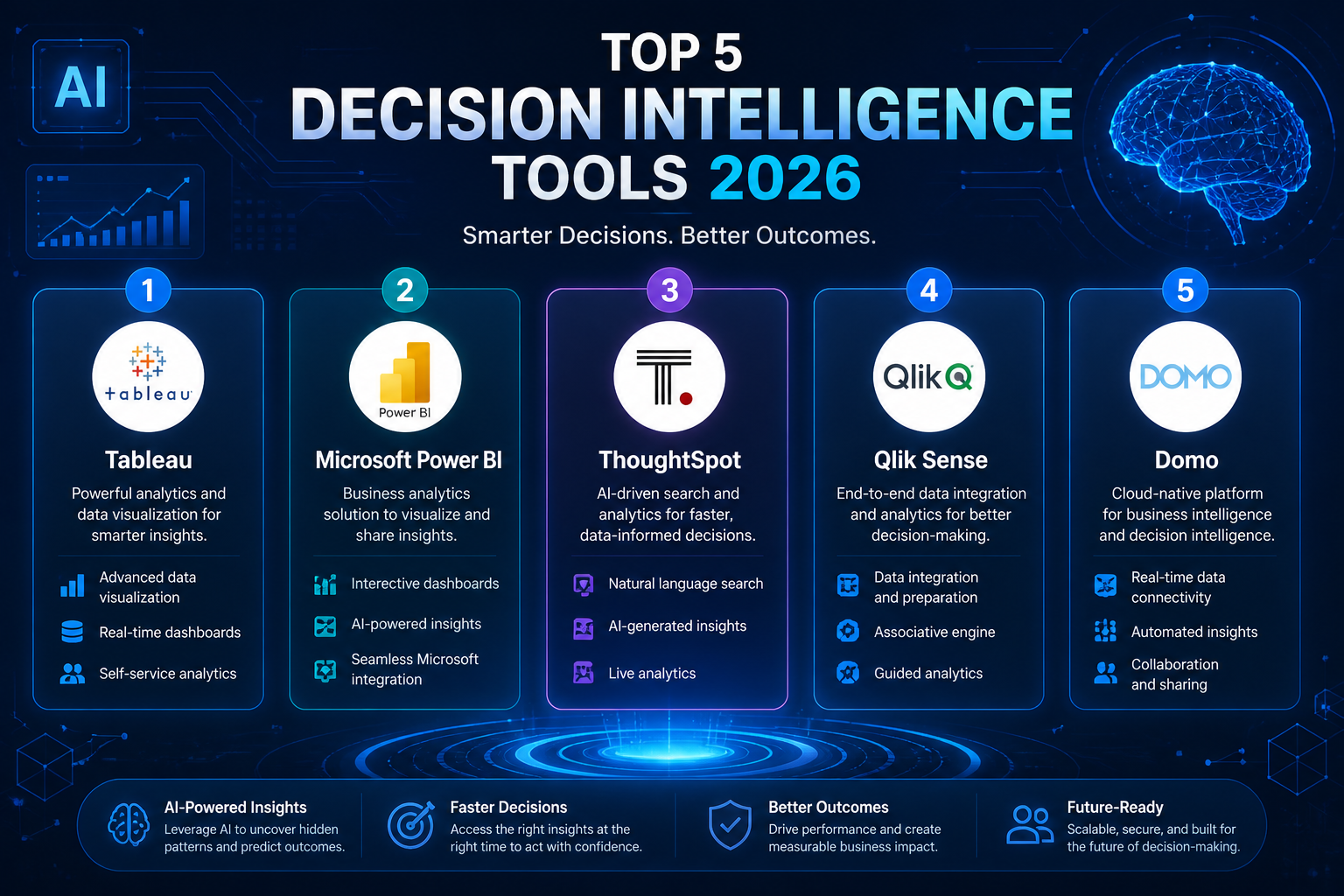
Top 5 Decision Intelligence Tools for 2026: Expert Review & Comparison

Introduction
 
In today’s data-driven business landscape, making informed decisions quickly isn’t just an advantage—it’s a necessity. As we navigate through 2026, decision intelligence platforms have evolved from nice-to-have tools to essential business infrastructure. According to recent market analysis, the Decision Making AI market was valued at $10,720 million in 2024 and continues to grow exponentially.
 
But with dozens of platforms flooding the market, how do you choose the right one for your organization?  We’ve tested, analyzed, and compared the leading decision intelligence tools to bring you this definitive guide to the top 5 platforms dominating 2026.


What Are Decision Intelligence Tools?

Decision intelligence platforms (DIPs) are advanced software solutions that enable organizations to design, manage, and automate decision-making processes by connecting data sources, applying AI/ML models, and delivering actionable insights.  These platforms bridge the gap between analysis and execution, transforming raw data into tailored recommendations and dynamic workflows.

In 2026, what makes the landscape different is the direct integration of Decision Intelligence into core business systems like ERP, CRM, and supply chain management.


The Top 5 Decision Intelligence Tools for 2026

1. SAS Decision Intelligence Platform

Best For: Enterprise-level organizations requiring comprehensive analytics and governance
 

Overview: SAS has been recognized as a Leader in the Gartner® Magic Quadrant™ for Decision Intelligence Platforms 2026 for its Ability to Execute and Completeness of Vision.  The platform provides a unified decision intelligence solution that improves decision-making, increases efficiency, enhances collaboration, and provides better governance.

Key Features:
  • Advanced AI and machine learning capabilities
  • Real-time decision automation
  • Comprehensive risk management tools
  • Industry-specific solutions (banking, healthcare, retail)
  • Strong governance and compliance frameworks
 
Pricing: Enterprise pricing (contact for quote)
 
Pros: ✓ Market leader with proven track record ✓ Extensive integration capabilities ✓ Robust security and compliance ✓ Excellent customer support
 
Cons: ✗ Higher price point ✗ Steeper learning curve for non-technical users
 
Best Use Case: Large enterprises in regulated industries requiring sophisticated decision automation with strong governance.


2. Aera Decision Cloud

Best For: Autonomous decision-making and cognitive automation
 

Overview: Aera Technology ranks among the world’s top vendors of decision intelligence platforms in 2026 according to Gartner. Aera’s platform specializes in cognitive decision intelligence, enabling autonomous decision-making at scale across complex business operations.

Key Features:
  • Autonomous decision-making agents
  • Natural language processing interface
  • Real-time operational intelligence
  • Cross-functional workflow automation
  • Predictive and prescriptive analytics
 
Pricing: Starting at $50,000/year (enterprise)
 
Pros:
✓ Cutting-edge autonomous AI capabilities
✓ Intuitive natural language interface
✓ Rapid deployment (weeks, not months)
✓ Strong ROI tracking
 
Cons:
✗ Premium pricing
✗ Best suited for larger organizations
 
Best Use Case: Organizations seeking to automate complex operational decisions across supply chain, finance, and sales operations.


3. Pyramid Analytics

Best For: Business intelligence and collaborative decision-making
 

Overview: Pyramid Analytics has established itself as a leading decision intelligence solution for 2026, offering a comprehensive platform that combines BI, analytics, and decision intelligence.  The platform is rated 3.7/5.0 in recent comparisons.

Key Features:
  • Unified analytics platform
  • Collaborative decision workspaces
  • AI-powered insights generation
  • Embedded analytics capabilities
  • Multi-cloud deployment options
 
Pricing: Starting at $35/user/month
 
Pros:
✓ User-friendly interface
✓ Strong collaboration features
✓ Flexible deployment options
✓ Competitive pricing
 
Cons:
✗ Limited advanced AI features compared to leaders
✗ Smaller ecosystem of integrations
 
Best Use Case: Mid-size to large organizations prioritizing collaborative decision-making and self-service analytics.


4. FICO Decision Management Platform

Best For: Risk management and customer engagement decisions
 

Overview: FICO is recognized as one of the top decision intelligence platform vendors in 2026, particularly excelling in risk management and customer decisioning.  The platform has decades of expertise in predictive analytics and decision automation.

Key Features:
  • Advanced decision rules engine
  • Predictive analytics models
  • Customer decision hub
  • Fraud detection and prevention
  • Credit risk assessment tools
 
Pricing: Enterprise pricing (contact for quote)
 
Pros:
✓ Industry leader in risk analytics
✓ Proven ROI in financial services
✓ Comprehensive decision automation
✓ Strong regulatory compliance
 
Cons: ✗ Primarily focused on financial services ✗ Complex implementation
 
Best Use Case: Financial services, insurance, and telecommunications companies requiring sophisticated risk and customer decisioning.


5. Energent.ai

Best For: No-code AI analytics and business strategy
 

Overview: Energent.ai has emerged as the #1 ranked decision intelligence platform for business strategy in 2026, boasting an impressive 94.4% analytics accuracy rate, outperforming many competitors including ChatGPT.  The platform is specifically designed for no-code AI decision intelligence.

Key Features:
  • No-code AI analytics interface
  • 94.4% analytics accuracy
  • Automated insight generation
  • Business strategy optimization
  • Real-time data integration
 
Pricing: Starting at $499/month
 
Pros:
✓ Highest analytics accuracy in market
✓ No coding required
✓ Quick implementation
✓ Affordable for SMBs
 
Cons:
✗ Newer platform with less market presence
✗ Limited advanced customization
 
Best Use Case: Small to mid-size businesses seeking powerful AI analytics without technical complexity.


Quick Comparison Table

 
Platform
Best For
Pricing
Accuracy
Ease of Use
Enterprise Analytics
$$
92%
Medium
Autonomous Decisions
$$
91%
High
Collaborative BI
$
88%
High
Risk Management
$$
93%
Medium
No-Code AI
$$
94.4%
Very High


Key Trends in Decision Intelligence for 2026

As you evaluate these platforms, it’s important to understand the broader trends shaping the decision intelligence landscape:
 
  1. Generative AI as a Strategic Decision Engine – AI is moving beyond analysis to actively generating strategic options
  2. Autonomous AI Agents – Post-2026, AI decision processes are increasingly managed by autonomous agents capable of handling complex workflows
  3. Explainable AI – Responsible and transparent AI decision-making is becoming a requirement, not a luxury
  4. Integration with Core Systems – Direct integration with ERP, CRM, and operational systems is now standard
  5. Collaborative Decision Intelligence – Platforms are emphasizing human-AI collaboration over pure automation


How to Choose the Right Decision Intelligence Tool

Selecting the right platform depends on several factors:
 

Consider Your Organization Size:

  • Enterprise: SAS, FICO, Aera Technology
  • Mid-Market: Pyramid Analytics, Aera Technology
  • SMB: Energent.ai, Pyramid Analytics
 

Evaluate Your Use Case:

  • Risk & Compliance: FICO, SAS
  • Operational Automation: Aera Technology, SAS
  • Business Intelligence: Pyramid Analytics, Energent.ai
  • Customer Engagement: FICO, Aera Technology
 

Assess Technical Capability:

  • High Technical Resources: SAS, FICO
  • Limited Technical Resources: Energent.ai, Pyramid Analytics


Frequently Asked Questions

Q: What is the ROI of decision intelligence platforms? A: Organizations typically see 20-40% improvement in decision speed and 15-30% reduction in operational costs within the first year of implementation.
 
Q: How long does implementation take? A: Implementation varies by platform: Energent.ai (2-4 weeks), Pyramid Analytics (4-8 weeks), SAS/FICO (3-6 months), Aera (6-12 weeks).
 
Q: Do I need data scientists to use these platforms? A: Not necessarily. Platforms like Energent.ai and Pyramid Analytics are designed for business users with no-code interfaces, while SAS and FICO benefit from data science expertise.
 
Q: Can these platforms integrate with our existing systems? A: Yes, all top platforms offer extensive integration capabilities with major ERP, CRM, and data warehouse systems.


Conclusion

The decision intelligence landscape in 2026 offers powerful solutions for organizations of all sizes. Whether you’re an enterprise needing the comprehensive capabilities of SAS or FICO, or a growing business seeking the accessibility of Energent.ai, there’s a platform designed for your needs.
 
The key is to align your choice with your specific business objectives, technical capabilities, and budget constraints. Remember, the best decision intelligence tool is the one that your team will actually use to make better decisions faster.
 
Ready to transform your decision-making? Start with a proof of concept with your top 2-3 choices, involve end-users early in the evaluation process, and prioritize platforms that offer strong training and support.